Table of Contents
To approve ream wrapper winding direction, agree on a drawing that shows the printed face, the web leaving the roll, the artwork edge entering the machine first, and the side carrying any registration mark. Check that drawing against the wrapping line's approved threading path. A note saying "print outside" or "clockwise" does not describe all of these relationships.
For a paper mill or private-label buyer, the practical question is whether the delivered roll will present the right surfaces and graphics at the wrapping station. A finished ream sample cannot answer that on its own. Before releasing production, connect the artwork approval to a physical roll orientation, a machine reference, and a named person responsible for confirming the setup.
What the Winding Instruction Needs to Identify
Treat the winding instruction as a small drawing, not a single purchasing abbreviation. Label the reference face of the web, show the direction of travel, and identify a recognizable feature in the artwork. The converter and the wrapping team should be able to look at the same drawing and point to the same leading edge without turning the page around.
The SPMC white paper hosted by the Institute of Packaging Professionals distinguishes coating or sealant wound in or out from the orientation of printed material. Its discussion explains why the final processing equipment matters when specifying unwind. Although written for sterilization packaging, this general rollstock distinction is useful here; it is not a copy-paper packaging standard. See the wind-direction section of A Guide to Writing Rollstock Specifications.
For the approval record, give each face a name that remains understandable even when the roll is wrapped for delivery. "Face A: printed display face" is clearer than "front." If the material has a designated bonding or contact face, identify that separately from the artwork. Do not assume the visible printed surface identifies every functional layer.
Start at the Wrapping Line, Not the Artwork File
Ask the production team for the approved web path for the specific line and pack format. The relevant reference is the setup used to produce acceptable reams, not a general machine photograph. A model number helps identify the equipment, but modifications, loading arrangements, and installed options still need confirmation by the equipment owner.
Have a trained operator record the roll position and the web's route to the forming area using the site's safe inspection procedure. Mark which edge runs on the operator side and which face is visible at an accessible reference point. Photograph that point with the machine stopped and secured as required by the manufacturer. Never reach into a running web path to obtain a better picture.
An approved roll already running successfully is valuable evidence. Keep its supplier label and a marked section of wrapper together. Without the label, a sample may identify the design but not the roll revision. Without a marked travel direction, a loose sheet can be rotated until almost any proposed layout appears to match.
If two factories will use the same branded wrapper, obtain a confirmation from each factory. Shared artwork does not establish that both lines need the same unwind configuration. Keep separate machine-specific variants where necessary rather than leaving operators to resolve the difference on arrival.
Separate the Printed Face from the Bonding Face
Printed-side orientation and material suitability are separate approval questions. The first concerns how the graphics arrive at the forming station. The second concerns whether the specified construction works with the actual folding and closure process. Both need a clear answer, but approving one does not approve the other.
Huasheng's printed packaging roll for copy paper reams lists a printed and laminated construction incorporating an 18-micrometre biaxially oriented polypropylene (BOPP) film. That product detail helps identify the material being discussed. It does not, by itself, establish a compatible sealing surface, adhesive, temperature, or winding configuration for a particular machine. Confirm those details for the construction being ordered.
On the sample, identify the face intended to remain visible on the finished ream and any surface designated for bonding. If the supplier uses different terminology, translate it into the same labels on the approval drawing. Avoid approving a description such as "lamination outside" when neither party has stated whether "outside" means the outside of the roll or the outside of the finished pack.
This distinction also matters during troubleshooting. A wrapper that is correctly oriented can still have a closure problem. Once orientation is confirmed, investigate material and process compatibility separately using the copy paper wrapper seal-failure checklist.
Define the Leading Artwork Edge and the Viewing Position
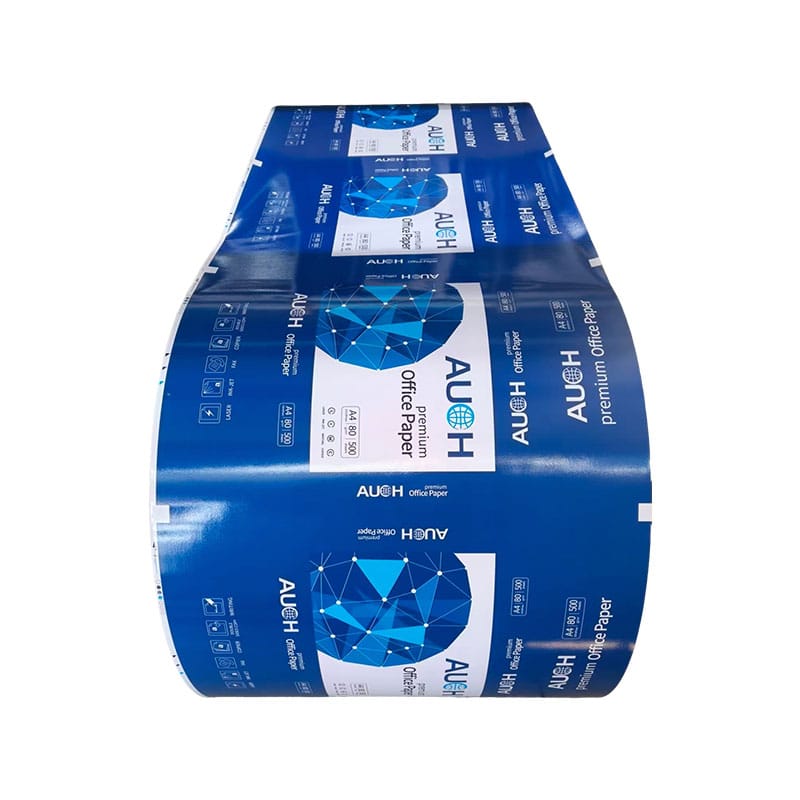
Select a feature that is easy to recognize: the top of the main brand panel, a clearly named end panel, or a specific corner of the approved artwork. Draw an arrow showing which feature advances first. "Top first" becomes meaningful only after the drawing defines the top of the artwork.
Then label the viewpoint. Clockwise rotation reverses when viewed from the opposite end of the roll, so "clockwise unwind" without a viewing position leaves room for two interpretations. A simple side view can identify the observer's position, the core, and the point where the web leaves the roll. A second view of the flat web can identify the printed face and leading artwork edge.
For example, an illustrative approval might state that the named brand-panel edge leads while Face A is visible in the attached flat-web view. The wording should refer to an actual annotated drawing, not replace it. The machine team must confirm that the pictured arrangement produces the intended finished pack on its approved threading path.
Numbered unwind charts are useful when both parties reference the same chart and revision. Do not approve "direction 4" from a purchase order while the converter works from a different chart attached to an older email. Attach the selected diagram to the order, mark the approved option, and keep the numbering as a convenient reference rather than the sole instruction.
Check Print Repeat and Registration Marks Separately
Ream wrapper print repeat describes the distance along the web between equivalent positions in successive package designs. Winding direction describes how that printed web is presented to the line. A roll can have the correct repeat but the wrong orientation, or the correct orientation with a repeat that does not suit the intended pack setup.
For the approval drawing, dimension repeat between clearly identified reference points and state the unit. Use the supplier's finished-web specification and the wrapping team's requirements; do not infer the cut length from a picture of the ream. Fold allowances, overlaps, and the relationship between the artwork and cutting position must be reviewed for the intended package.
Where the machine uses an optical registration mark, have its equipment owner confirm the required mark position and detection arrangement. Record the mark's location relative to a named web edge, its position within the repeat, and its relationship to the intended cut. Mark size, contrast, clearance, and acceptable variation are equipment-specific approval items, not values to borrow from another buyer's wrapper.
On a line configured to follow that mark, the sensor needs to encounter the intended mark on the expected path. Turning the roll around may relocate that path even if the graphics still look readable. Before changing anything, compare the delivered web with the approved drawing. Do not assume that a registration problem is a winding fault: sensor setup, artwork changes, and repeat variation require their own checks by qualified personnel.
Put the Approval on One Controlled Sheet
The purchasing record should allow someone who was not involved in the original discussion to identify the approved roll. A compact sheet with two annotated views is usually more useful than several unconnected photographs. Keep the full dimensional specification alongside it; the orientation sheet is not a substitute for core, width, diameter, and handling requirements.
| Approval item | What to record | Who should confirm it |
|---|---|---|
| Reference faces | Face A and Face B, with printed and functional surfaces identified | Converter and buyer's technical contact |
| Machine reference | Line identification, pack format, and approved threading reference | Wrapping-line owner |
| Roll side view | Observer position, core, and web departure arrow | Wrapping-line owner and converter |
| Flat-web view | Leading artwork edge and direction-of-travel arrow | Artwork approver and production team |
| Registration mark, if used | Named web edge, mark position, and agreed detection requirements | Equipment owner and converter |
| Print repeat | Defined measurement points, unit, and agreed acceptance limits | Converter and production team |
| Approval identity | Artwork revision, drawing revision, sample reference, and approval date | Buyer responsible for release |
Before signing, ask one person from purchasing and one from production to describe the approved orientation using only that sheet. If their descriptions differ, revise the sheet. This is a simple documentation check, not a machine trial, but it exposes terms that depend on an unwritten assumption.
For the remaining roll dimensions, use the broader copy paper packaging roll specification guide. Keep the two records under the same revision reference so a later width or artwork change does not leave an obsolete orientation drawing in circulation.
Verify the Sample Before Releasing the Full Order
A digital artwork proof confirms content and layout, but it cannot demonstrate how the supplied roll will unwind. Request a physical sample suitable for checking the orientation. If it is a loose printed section rather than a roll, require the supplier to mark the intended travel direction and identify both faces. Record what that sample does and does not establish.
At the controlled trial, compare the sample with the signed drawing before testing production performance. Check the web as loaded, the artwork orientation at the agreed reference point, and the resulting pack. Where a registration mark is used, confirm its intended path through the detection arrangement. Let trained personnel operate and adjust the equipment under the site's procedures.
Retain the approved roll identification, a marked web section, and a finished ream from the trial. These three items answer different questions: what was supplied, how it was presented, and what the line produced. Record the material and artwork revisions as well as the machine setup reference. A successful sample does not approve a later unreviewed construction change.
If the trial fails, describe the observable mismatch before proposing a correction. "The named end panel arrives first instead of the brand-panel edge" gives the converter something specific to investigate. "Wrong direction" leaves the supplier guessing whether the issue concerns faces, rotation, artwork, or the sensor-side edge.
Handle Delivery Mismatches Without Losing Traceability
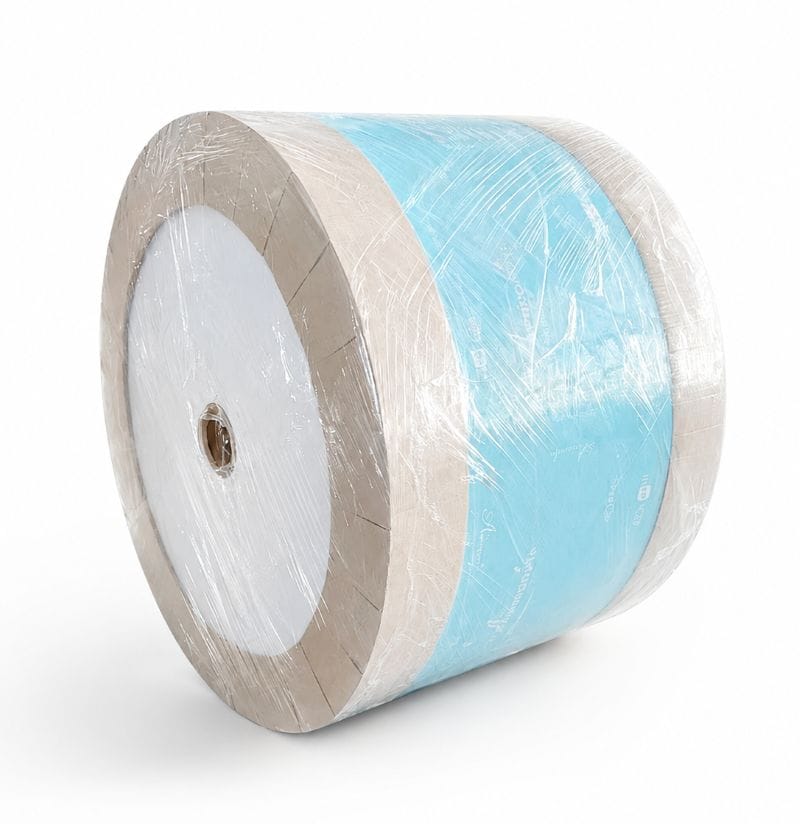
For incoming inspection, compare the roll identification with the released order and orientation drawing before the material reaches the line. Inspect the accessible leader using the agreed receiving procedure. Preserve labels and packaging information, especially when several artwork versions or line-specific rolls arrive together.
If orientation differs, identify and segregate the affected rolls while the discrepancy is reviewed. Do not relabel them as acceptable based only on a photograph of the outer layer. Send the supplier a photograph with the viewing position marked, the roll label, the approved drawing revision, and a description of the observed difference.
Rewinding may be a possible corrective action, but it is not an automatic remedy. The converter should assess the required orientation and any implications for roll build, splices, contamination control, identification, and material handling. Turning a roll end-for-end is also not a universal fix. Any proposed recovery must still match the approved machine path and finished-pack requirements.
Keep the original nonconformance record linked to the disposition. If recovered rolls receive a new identification, preserve the connection to the original batch. Otherwise, a later reorder may copy a delivery label without anyone knowing that the acceptable configuration resulted from a separate correction.
Carry the Approved Direction into Every Reorder
Once a wrapper runs correctly, put the orientation drawing reference on the repeat-order specification. Ask the converter to acknowledge the current revision rather than accepting a general "same as last order" confirmation. That phrase becomes unreliable when the last shipment contained multiple designs, machines, or corrected rolls.
Recheck the orientation when the artwork is rotated, the pack format changes, production moves to another line, or the conversion route changes. The review may be brief when nothing relevant has changed, but it should identify what was compared. A new logo position does not necessarily require a new unwind; a change affecting the leading panel or registration mark may require technical review.
To discuss a new roll with Huasheng, send the pack format, current wrapper construction, annotated unwind drawing, and relevant machine requirements through the packaging inquiry page. Include photographs of a known-good roll and its label where available. Ask for confirmation of the proposed orientation and sample-approval steps before authorizing production.
Conclusion
Approve ream wrapper winding direction as a relationship between the roll, the artwork, and the wrapping line. A shared drawing, a traceable sample, and a recorded machine check make that relationship clear. Keep the approved reference with the order so the next delivery can be checked against evidence rather than someone's memory of which way the roll should turn.
Frequently Asked Questions
Is paper grain direction the same as winding direction?
No. Grain direction concerns the paper's fibre orientation; winding direction concerns how the web is arranged and supplied on the roll. If grain orientation is important to the specified wrapper, record it as a separate material requirement rather than using an unwind code to describe it.
Does a pre-cut wrapper need an unwind specification?
The buyer receiving pre-cut sheets does not load a roll, so an incoming-roll unwind instruction is not the relevant acceptance check. Sheet orientation, printed face, dimensions, and presentation to the wrapping operation still need agreement. The supplier may separately control roll orientation during conversion.
Can a finished ream establish the correct roll direction?
It establishes the intended finished appearance, but not the route the web took through the machine. Use it alongside a marked web sample and the approved threading reference. The same finished appearance alone is not sufficient evidence for a roll-loading instruction.
Should the supplier's unwind code appear on the roll label?
It is useful if the order defines that code and links it to an approved diagram. Include the product and revision identification needed to retrieve that diagram. A code without an accessible reference gives receiving staff little basis for checking the material.
What should a buyer provide when no approved roll is available?
Start with the intended pack layout and the equipment owner's web-path requirements. Ask the converter to propose an annotated orientation drawing for review, then agree on a suitable sample or trial. Do not choose a direction solely because it is used by another paper mill.